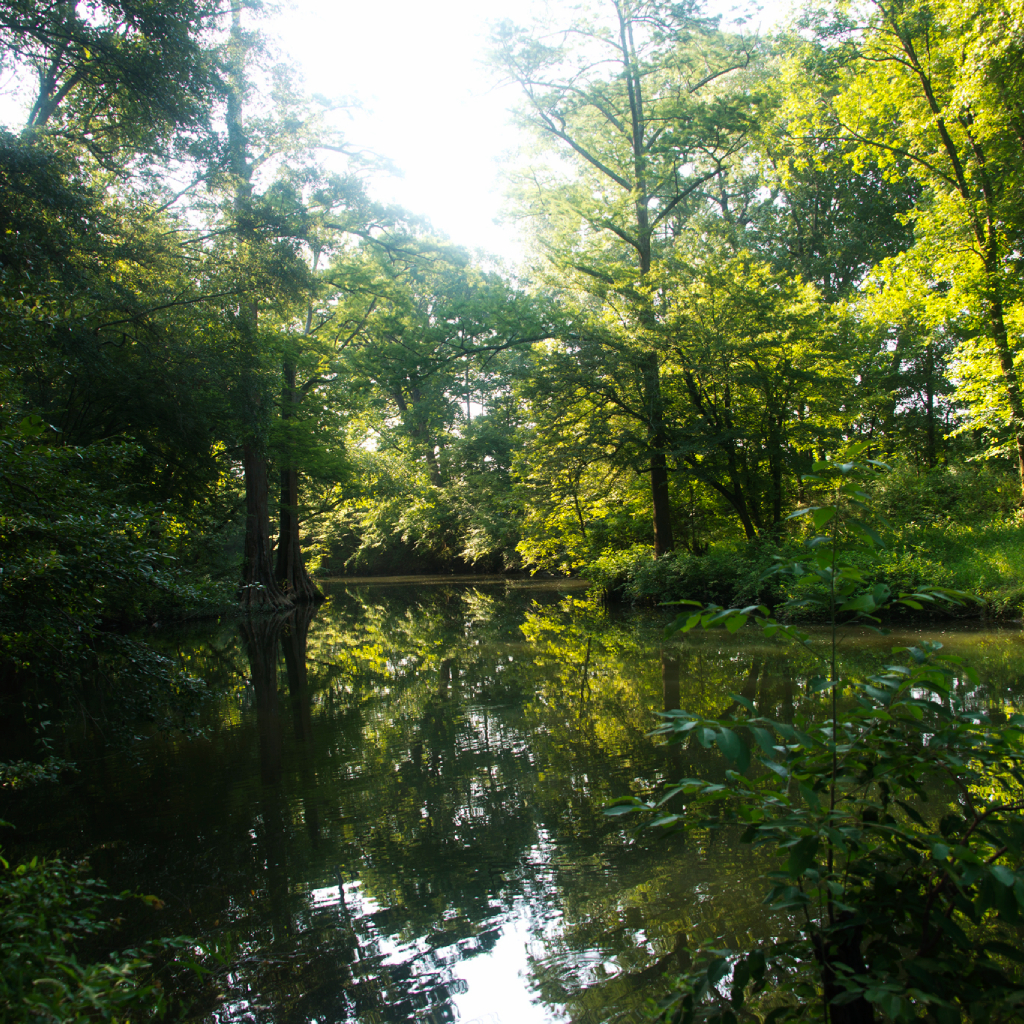
The above photo is not of Boggy Creek (which is indeed a real place) but rather of the Little Maumelle River. I captured this slice of the river on a hot and humid Wednesday morning in July of 2023. Passing south of Pinnacle Mountain on the outskirts of Little Rock. But it most definitely could pass for Boggy Creek. The terrain is identical. As is the eerie calm that embodies both peace and danger. You could just as likely nap on the banks of the river without worry or find yourself at the mercy of a monster lurking in the dense and shadowy flora.
The Legend Of Boggy Creek
The Legend of Boggy Creek is indeed a legend unto itself. This 1972 film based on the Fouke Monster – a bigfoot-like creature – alleged to inhabit the swamps of Southwest Arkansas is not only a horror classic but a hallmark of American independent cinema. Produced for $160,000 (meager even by 1972 standards), it would gross an estimated $25,000,000 during its multiple 1970s theatrical runs. Launching the career of its director, the late Charles B. Pierce, he followed this commercial and critical triumph with a string of successful genre films throughout the 1970s and into the 1980s.
For years, The Legend of Boggy Creek was only available to view on various unauthorized DVD releases that ripped VHS releases. This is how I first watched it. In short, while the excellent storytelling shined regardless, it looked terrible in that washed-out, pan-and-scan cut. Pierce’s daughter, Pamula, eventually acquired the film and commissioned a 4K restoration. Released in 2019, this remastered version plays as it did in drive-in theatres in the seventies. In widescreen with the gorgeous Arkansas wilderness showcased in all its richly colorful glory. Judging by the trailer, I must make time to watch it.
Much has already been written about the artistic merits of The Legend of Boggy Creek. I have nothing to add in that regard. Other than recommending it to fans of horror and independent films as well as to anyone interested in Arkansas history and culture. It’s by no means a perfect film (“Hey, Travis Crabtree”) but a well-produced one under the conditions in which it was brought to life. And that’s why I’m authoring this piece. As I encourage my website visitors to take advantage of the possibilities surrounding them and make their own fun, it’s vital to spotlight individuals who did just that. Charles B. Pierce fits this bill to a T. An Arkansan with enough ingenuity and will to power to make the most out of seemingly so little around him. Most people wouldn’t have bothered to try. Yet Pierce never said die. Resulting in a classic film occupying the same ‘low budget yet highly successful” 1970s cinematic pantheon as David Lynch’s Eraserhead and John Carpenter’s Halloween.

Get down and dirty to my exciting and provocative music by streaming it on Amazon, Apple, Boomplay, Deezer, iHeart, Pandora, Spotify, YouTube, and other platforms.
Arkansas Was What He Made It
Charles B. Pierce was, like me, not an Arkansas native. But he may as well have been after moving here from his native Indiana when only a few months old. Growing up in Southwest Arkansas, he began his media production career working on both sides of the camera at local television stations in Arkansas, Louisiana, and Texas. He then moved to Texarkana and opened an advertising agency. Ledwell & Son Enterprises was one of his accounts, and the commercials he produced of semi trucks and farm machinery in action became a television staple throughout the Southwestern United States. But Pierce was already moving onto bigger and better things when he approached L. W. Ledwell about funding a feature film. Ledwell was skeptical but nevertheless sold on Pierce’s enthusiasm and determination.
The Legend of Boggy Creek is the product of a creative and resourceful mind who observed all that was accessible to him, let his imagination run wild, and refused to let anything stop him. While not a believer of the Fouke Monster legend, Pierce found the folklore intriguing and a good basis for his film. Without access to experienced actors, he shot his film in a docudrama style. Weaving interviews with locals relating their alleged encounters with action-based dramatizations containing simplistic dialogue at most. Those latter roles filled by random individuals he approached at a local gas station. He made the most of the abundant natural beauty surrounding him. Capturing it on a camera he built himself. He even sang the theme song. Upon the film’s completion, he self-hosted showings in Texarkana which proved successful and led to domestic and foreign distribution deals.
Charles B. Pierce wanted to make a feature film. And he did it. Letting nothing stop him. Not the lack of access to millions of dollars, fancy shooting locations, a seasoned cast and crew, or even his own inexperience. He didn’t let the people who laughed at or blatantly tried to discourage him – and I guarantee there were many such losers – get to him. Nor did he worry about what the frigid battleaxes at the Junior League might think of him making a horror film in THEIR community. He embodied the Special Air Service’s “Who Dares Wins” motto and refused to use any threat, real or perceived, as an excuse to quit. Playing to win, rather than playing to not lose. And there’s a world of difference between the two. He proved that an ambitious cultural objective could be achieved in Arkansas. This was at a time when Hollywood was still the land of milk and honey for those with aspirations on either side of the camera. And, between his directorial efforts, Pierce himself would sometimes “moonlight” on Hollywood productions. Mainly as a set dresser. He also co-wrote 1983’s Dirty Harry installment Sudden Impact, but I digress.
Arkansas – like many places throughout the world – has a blank slate advantage with not much happening here. The expectations are low, and low expectations present a double-edged sword I know all too well. It’s easy to get cut down by scores of locals who ignorantly assume that, “If you were truly talented, you’d be big in Hollywood right now.” Or New York. Or Las Vegas. Anywhere with a storied show business reputation, really. But the other side of that blade presents a big fish in a small pond opportunity. A light-speed rail I’ve ridden to great effect at times. Pierce to a much greater effect. I also know what it’s like to fall off, and so did Pierce with 1985’s Boggy Creek II: And The Legend Continues (although I like it). But writing about this film has me gunning even harder to do bigger and better things.

My bare-all memoir Naked Ambition: A Male Stripper's True Account of Making Girls Behave Badly and its ultra-smutty companion novel Wild Nights of Arkansas Strippers: Based on a True Story are available in eBook and paperback from Amazon and other online retailers.
How I Make Arkansas What I Want
My morning walk takes me along a pond where mallard ducks live in a beautiful wooded cove. They don’t mind me because I’ll feed them when they stop by my home. I then walk along the tree line and enter the woods via a narrow creek bed. Onto private property. Shhh… Don’t tell anyone. It’s no big deal. Just undeveloped land that will someday be cleared, leveled, and filled with middle-class homes. In the meantime, it provides me with a small taste of wilderness adventure. My path crisscrossed with deer trails. One takes me up a mound overlooking another narrow creek bed. Along with deer, I occasionally spot bobcat tracks. Transients cross through these woods sometimes. Poachers too. Peace and tranquility with hints of danger. An ideal recipe for adventure.
The first act of my short film Murder On The Crack Whore Express – based on the true crime saga of El Dorado Jane Doe – consists solely of this scenery at dusk inspired by The Legend of Boggy Creek. Its enticing yet unnerving beauty setting the stage for the horror to come.

You can rock my provocative designs on your hot bod and bare walls with stylish and ready-to-print art and fashiion images available for purchase from me directly.
My short film deadly inTENTions likewise makes use of the forbidden woods and an abandoned tent that was briefly occupied by a meth addicted couple before they moved on. That there’s a killer in the woods needs no explanation. The forest is so spooky as to convince viewers that it could assume human form to kill intruders.
As with The Legend of Boggy Creek, the abundant natural beauty is an ideal place to start when making the most of my Arkansas experience. I write and speak often of the local scenery with a pastoral flair. And for excellent reason. Not in a saccharine and cynical Arkansas Tourism fashion but from a place of genuine affection. Enthusiasm for the chance to conquer a slice of it, however briefly, and make the fun I desire. To express myself creatively in line with my artistic vision. Even the most fun towns in Arkansas, such as Hot Springs, rely heavily on Mother Nature’s embrace from all angles. The best purely urban option for fun is Little Rock’s River Market District with its “pay a $10 cover on a Tuesday night and try not to get mugged for the sake of supporting muh local businesses” ethos presented as “fun” for the masses. And I know Little Rock is far from the only city with that issue these days.
That last statement is bold by design. It’s time to get bold and shape your experience as you see fit regardless of where you live. Charles B. Pierce, by all accounts I’ve read, was a bold individual. A man with a commanding presence that persuaded others to his way of thinking. He didn’t get The Legend of Boggy Creek made by begging or stealing per some asinine Mark Twain false dichotomy. Nor did he guilt trip people into the “support muh local filmmaker” grift. Rather, he believed in himself and made sure everyone around him knew it. That’s how he secured funding from L. W. Ledwell. How he convinced people to work on his production. And he couldn’t have achieved it any other way. He was a leader. A man capable of visualizing the big picture and bringing it to life. Fearless when it came to making bold moves.
This included thinking outside the box. Confirmed in my brief synopsis of the film’s production. Taking chances. And calculated risks. The people who scoff at my suggestion that Arkansas has potential for greatness never take chances. Never take risks. They complain about how lame it is here but do nothing to rectify that. And it would be the same story if these people were living in Colorado, Florida, or any other state perceived as being inherently better. Arkansas has its issues, no doubt. But so does everywhere else. These people would be wasting away no matter where in the world you stuck them.
Don’t make excuses. Make great things happen.